Capacity Planning for Kidney Services
The capacity planning process in BC is a collaborative effort involving BC Renal and the six-health authority renal programs. BC Renal serves as a central resource, overseeing province-wide planning, funding, and monitoring of kidney services.
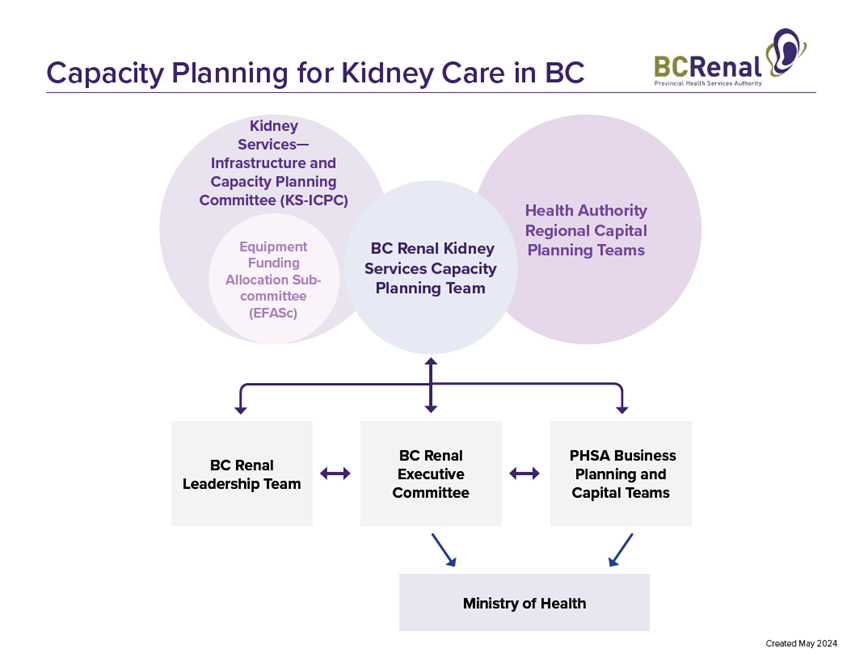
Two BC Renal (BCR) planning committees, alongside an internal capacity planning team, work together to ensure adequate infrastructure for kidney care. The Kidney Services -Infrastructure and Capacity Planning (KS-ICPC) Committee streamlines growth planning for renal facilities, while the Equipment Planning & Funding Subcommittee (EFAS) manages equipment planning, reviews funding requests, submits recommendations for approval, and efficiently manages equipment funding. Both committees prioritize enhancing provincial partnerships and fostering regional collaboration. While BC Renal oversees the allocation of fixed annual capital funding for equipment, BCR does not manage or allocate funds for facility development. All funding for health authority facilities should be accessed through their respective health authority capital planning teams.
Kidney Services – Infrastructure and Capacity Planning Committee (KS-ICPC)
The Kidney Services – Infrastructure and Capacity Planning Committee (KS-ICPC) serves as a provincial forum to facilitate and inform kidney care facilities planning across health authority renal programs in collaboration with key health authority (HA) and government partners. ICPC supports alignment and consistency in processes, advocacy for capital funding where appropriate, and ensures availability of services to meet patient needs.
Deliverables of the committee include:
- Submit a provincial capital. planning report annually to the BC Renal Executive Committee for review, along with proposed action items and requests.
- Submit an updated provincial 10-year capital project plan to the Ministry of Health annually.
Equipment Funding Allocation Subcommittee (EFAS)
The Equipment Funding Allocation Subcommittee (EFAS) facilitates provincial equipment planning, reviewing, and prioritizing equipment requests, submitting recommendations for approval, tracking, and reconciling associated funding approvals.
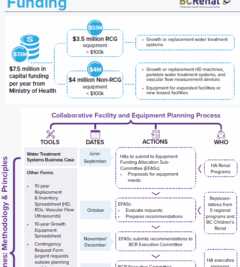
Refer to infographic below for more information on the equipment funding process.
Deliverables of the subcommittee include:
- Submit priority ranked equipment report annually to the BC Renal executive for review and approval.
- Submits an updated provincial equipment plan to the Ministry of Health via BC Renal / PHSA annually.
Advocacy
BC Renal and PHSA work collaboratively with the health authority renal programs to advocate for dialysis capacity and facility needs that require multiple sources of capital funding.
A set of provincial renal program guidelines endorsed by the Ministry of Health provides a methodology and set of principles for health authorities and institutions to follow in the management and ongoing development of care programs. The guidelines support equitable distribution of high-quality kidney care to patients across BC. These guidelines are posted on the BC Renal website.
Renal Equipment Funding